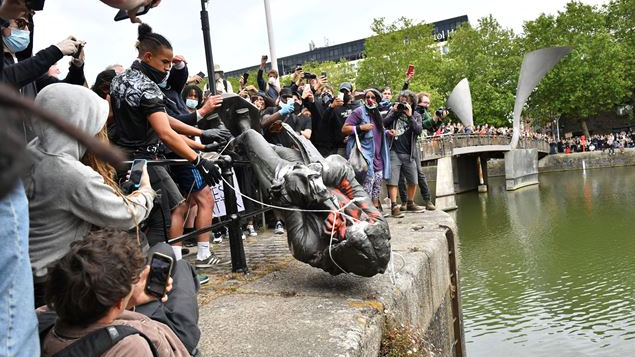
One of the most eye-catching incidents in UK protests sparked by the death of George Floyd was the destruction of a bronze statue depicting Edward Colston, a 17th century slave trader and philanthropist. The Colston statute, which stood in the city centre of Bristol for more than 100 years, has long been a focus of controversy. Colston invested a lot of money in the city of Bristol in his life time. However, his huge wealth was amassed through the transportation of tens-of-thousands of African slaves.
At the weekend, Colston was toppled from his marble perch by protestors and rolled towards Bristol harbour where he was swiftly dumped into the brine. It’s a striking metaphor, the bronze representation of a man complicit in the subjugation and murder of Africans, including by drowning as many were cast over the side of slave ships, being dispatched to the sea in a similar fashion.
The public will have different views on the destruction of Colston’s statute. Some will say vandalism is unacceptable, no matter how moral the cause it is carried out in the name of. There are democratic means to achieve something like the removal of a statue. Others will say the statue has stood for too long and that radical steps were necessary to remove it. What is undeniable is the message that was sent trough this act – ‘slavery is evil, and we the people won’t stand for any veneration of those who condoned it’.
In the last few days, other statues depicting less contentious figures have also been defaced. In London, a plinth bearing the name of Winston Churchill was spray painted with the words ‘was a racist’. That Churchill had flaws is undeniable. Did he harbour prejudice? Perhaps. But he was also a fearless wartime leader whose efforts helped to defeat one of the most brutal, racist regimes of the 20th century. Isn’t this worth commemorating?
“Colston’s deposition was a striking metaphor”
The people we venerate from our history and the manner in which we do this is a complicated issue. No human being is perfect, all are sinful, and there will always be flaws to point out. Indeed, William Wilberforce, the politician credited with abolishing slavery in the UK, consistently voted for controversial legislation that undermined the freedoms and protections of British citizens. How does he weigh in the balance of modern opinion?
We should not judge people exclusively by modern standards. Neither should we ignore their flaws. A proper rendering of history must explain the good people achieved, the bad they allowed and explain the context and moral framework of their time as it compares to today. In appreciating their lives holistically we learn from them and, hopefully, avoid repeating the mistakes they made. Perhaps statues are not the most fitting representation of history. Maybe all statues of slave traders should be removed. But their names should never be erased from the history books.
One question we may ask after the destruction of Colston’s statue is ‘which effigies will our society be dragging down 100 years from now?’
The protests that led to Colston’s deposition were over racism, which is rightly recognised as an unspeakable evil. The West has come a long, long way since the days of the slave trade. However, our society still entertains huge injustice. Another great evil persists in UK society today. It is normalised and profit-driven. Abortion.
“Which effigies will our society be dragging down 100 years from now?”
Abortion sees the most vulnerable category of human beings, the unborn, killed in the womb. To date, since the legalisation of the practice in 1967, more than 9 million unborn babies have aborted in the UK alone. Today, it’s around 180,000 every single year. Abortion providers like Marie Stopes and BPAS receive NHS money for carrying out abortions, giving them a financial incentive to carry out more and more.
Women in the UK are being sold the lie that the new life in their womb is expendable. This despite the fact that abortion not only destroys a baby’s life, but a mother’s mental and physical health. There are many options aside from abortion but these are rarely presented to women, or taken up in lieu of abortion’s ‘quick fix’.
Like the slaves of the 17th century, the unborn are considered devoid of rights. The powerful exploit the weak and deny them the most basic right, life. And like the public of the 17th century, UK citizens are told that the subjugation of this class of human beings is morally defensible. ‘It’s for the mother’s wellbeing’. ‘It’s her right to choose’. If slavery was tolerated because it was perpetrated far away from the eyes of Britons, abortion too is tolerated because it is never seen. It’s carried out behind closed doors, and never once questioned by the media and political elite. Criticism of abortion is the one taboo.
We must pray for a future when the great perpetrators of abortion are held in the same light as Edward Colston. When the words ‘Marie Stopes’ and ‘BPAS’, are uttered only as examples of a bygone and immoral industry, complicit in the destruction of unborn babies and the ruining of women’s lives. By acting now, and challenging abortion, by speaking out in defence of the unborn and women, it may not be 100 years until this occurs.
 salann