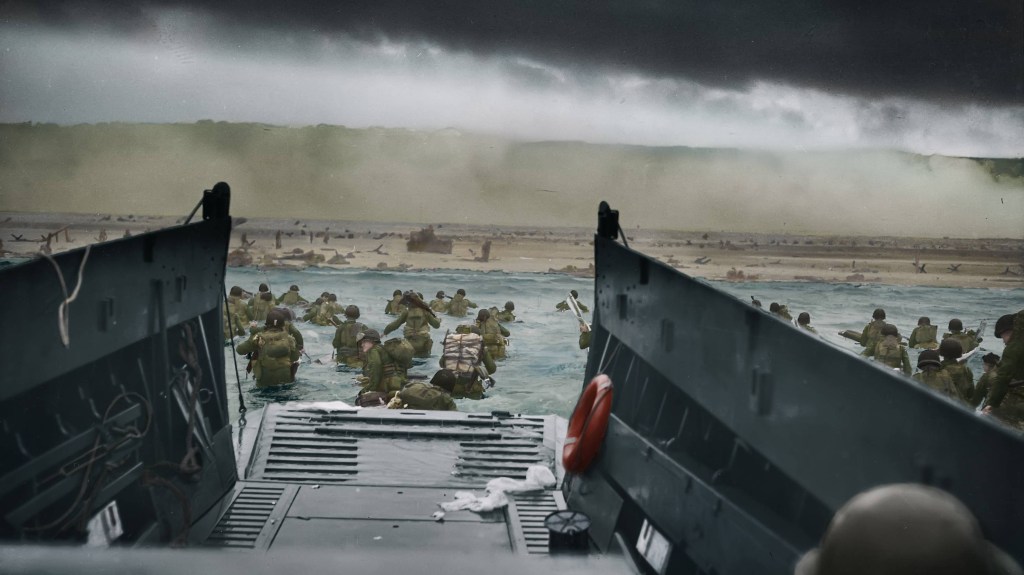
Today marks 76 years since D-Day, the first assault in the Battle of Normandy which resulted in the Allied liberation of Western Europe from Nazi control. On 6 June 1944, some 156,000 British, American and Canadian troops landed on five beaches along the heavily-fortified coast of Normandy, France. The operation was one of the largest amphibious military assaults ever carried out and was a great feat of military strategy.
Hitler believed that the D-Day landings were a feint designed to distract the Germans. Because of this, he initially refused to release nearby divisions and armoured vehicles to repel the attack. This misjudgment proved fatal. Less than a week after D-Day, all five beaches were secured and a base had been established for hundreds-of-thousands of troops, vehicles and provisions to be landed in preparation for the coming campaign. By August 1944, the whole of Northern France had been liberated, and by spring 1945 the Allies had defeated the Germans.
Today, we remember those who paid the ultimate price. According to some estimates, more than 4,000 Allied troops were killed on D-Day itself. During the Battle of Normandy, more than 200,000 Allied troops were killed, wounded or declared missing in action. The bravery of Allied troops ensured the defeat of Nazism and the liberation of millions of innocent men, women and children from the grip of the Third Reich. We owe our freedoms today to the grace of God and that brave generation of young men.
“We owe our freedoms today to the grace of God and that brave generation of young men”
The Second World War was a tremendous shock to Britain, only a few decades after the ‘war to end all wars’, World War One. It challenged afresh the ideas of Enlightenment thinkers such as Jean-Jacques Rousseu that mankind is “naturally good”. The belief that through technology, education and socialisation, hatred, oppression and injustice could be ‘solved’. Pre-Second World War Germany had, after all, been a cradle of cultural, industrial and scientific endeavour. How did it all go so terribly wrong?
As Nazi Germany advanced in its campaign of terror, as Europe was plunged into all out war, the citizens of the British Isles were faced with the same age-old existential questions: ‘Why is there evil in the world?’ ‘Why is there suffering?’ ‘Is there any hope for us?’ Thankfully, there was someone to provide answers.
By the 1940s, Christian writer and scholar C.S Lewis had gained some prominence and during the war years, he produced some of his most powerful work. It can be no coincidence that his famous books “The Problem of Pain” (1940) and “The Screwtape Letters” (1942), addressing the reality of suffering and evil, emerged at that time. Lewis also gave a series of war time talks on the BBC. The material from these talks later became part of “Mere Christianity”, an exposition of the Christian faith.
“During the Second World War, C.S Lewis produced some of his most powerful work”
As men and women grappled with fear, suffering and death, Lewis pointed them to the reality of sin. Mankind, he contended, cannot place its hope in itself. Left to our own devices, we are doomed. One notable address by Lewis came at the start of the war. In a sermon he preached in Oxford entitled “Learning in War-Time”, Lewis preached:
“All the animal life in us, all schemes of happiness that centered in this world, were always doomed to a final frustration. In ordinary times only a wise man can realize it. Now the stupidest of us know. We see unmistakably the sort of universe in which we have all along been living, and must come to terms with it. If we had foolish un-Christian hopes about human culture, they are now shattered. If we thought we were building up a heaven on earth, if we looked for something that would turn the present world from a place of pilgrimage into a permanent city satisfying the soul of man, we are disillusioned, and not a moment too soon.”
Humanity is not inherently good. We are living in a fallen world, spoiled by sin. It will never be made perfect by man’s efforts. The root of all suffering and evil, at a national, local and individual level is sin, which dwells irresistibly within the heart of every human being. The situation is even more serious than we might imagine. Human beings are culpable for the sin they commit against one another and against the Creator, God.
“The root of all suffering and evil, at a national, local and individual level is sin”
Lewis saw parallels between the Second World War and a much more terrible, cosmic battle that has raged throughout time – the battle for human souls.
In “The Screwtape Letters”, a fictional dialogue between a senior demon and his junior, Screwtape, he portrayed the subversive tactics of the devil, perpetrated in the hearts and minds of human beings. The devil’s warfare never lets up, in war time and in peace. His goal is to deceive human beings about sin, their accountability to God and have them sleepwalk through life into a lost eternity. After death comes judgment, when all mankind must give an account before God. The penalty for sin is eternal damnation and we are all guilty, each and every one.
But there is good news.
Lewis, like all Christians, pointed people to the cross. Like D-Day, the cross was God’s military masterstroke, a turning point in the great cosmic war. Through it, Jesus Christ, God’s Son, accomplished final victory over the devil by paying the ransom for our sins. By repenting and placing our trust in Christ, we can stand acquitted before God on the day of judgment, and gain eternal life.
In these days of coronavirus men and women are contending with many of the same existential questions their grandparents grappled with in the 1940s. They’re troubled by suffering, they’re scared and they realise their own fragility in a way that perhaps they hadn’t before. What will our answer be?
Like C.S Lewis, we must take the opportunity to point people to Christ, and tell them the good news. There is a reason for suffering – sin. There is an antidote to fear – faith. And there is an escape from death – Jesus Christ. May the Gospel be our answer in these times, and in every season.

