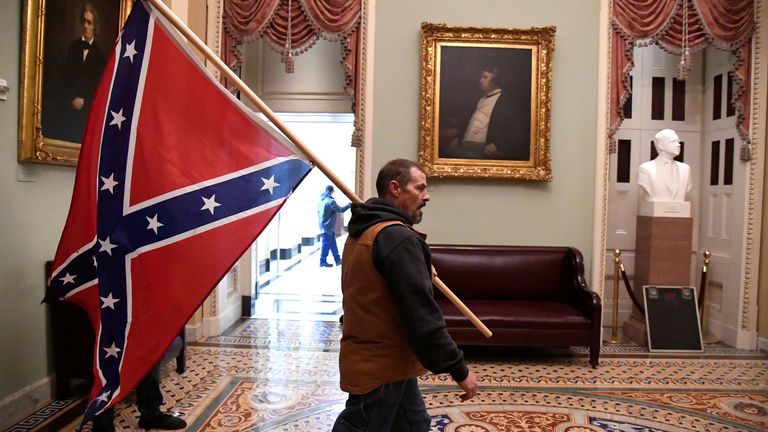
Unless you’re located on the planet Mars, you will have seen the disturbing scenes at Capitol Hill, Washington DC this week. On Wednesday, hundreds of pro-Trump protestors stormed the US Congress buildings seeking to obstruct a symbolic vote that confirms Joe Biden as President Elect. Some protestors made it as far as the floor of Senate, whilst crowds of camouflage-wearing thugs freely roamed the estate. In the chaos that ensued, five people died and numerous others were injured.
Three aspects of this week’s events were particularly shocking. Firstly, the fact that they occurred in the United States. The scenes that graced our news bulletins this week are more typical of a banana republic than a functioning democracy. Nobody alive in the US today will remember a time when the seat of democracy itself, Congress, was overrun by a marauding crowd of protestors. Respect for Congress and all that it symbolises has remained intact, even during scandal, economic turmoil and contentious military conquests.
Secondly, many were appalled at the actions of the President himself. In the hours leading up to the chaos, Trump was recorded whipping supporters into a frenzy. He told them that elections in “third-world countries” were more honest and later added: “You have to show strength.” There are calls for Trump to be removed from office for being complicit in what happened. Notably, Vice President Mike Pence has also distanced himself from the President and criticised his actions.
Thirdly, people were dumbfounded that security forces could be so unprepared for what happened. Perhaps it was down to a lack of planning, or a failure of Government under the helmsmanship of Trump. Some commentators have suggested collusion between the two groups, citing pictures of officers posing with protestors in the halls of Congress. One thing is certain: the response should have been much faster, and much more robust.
It will take time to analyse what happened this week. How was a crowd that large allowed to walk up to the seat of Government in the United States and gain entry? Why, precisely, were protestors prepared to make such a daring move? It felt like a coup, not a protest. There will also be scrutiny of the emotions behind the protest – the sparks that ignited the flame of insurrection. Amidst this speculation, however, we must not miss the wider issues at play. This was not an isolated event and it is unlikely to be the last such outpouring of anger by US citizens.
The disgraceful events of this week should serve as a wake-up-call to the United States, and indeed the United Kingdom. Something is deeply wrong with our politics. Since the 1950s, Governments in both nations have swung from the left to the right. Voters have disagreed strongly on a vast array of political and philosophical subjects. However, for the most part, citizens have expressed their views democratically at the polling booth, via open, tolerant debate and through peaceful protest. Rarely has it come to civil disobedience.
Today, it seems that voters are simply unable to reconcile their differences. Culture is more divided, more hostile and political disagreement increasingly leads to violent confrontation. This is a sharp contrast to the 1960s, for example, when Matin Luther King led an overwhelmingly peaceful movement for civil rights – despite the deep tensions in American culture, and despite the blatant injustices black Americans were facing every single day. These days, young people are far more willing to abandon peaceful advocacy in favour of disruptive measures.
Many books could be written on the reasons for this but surely a large factor in the deepening tensions of recent years has been the advancement of identity politics or, as the Americans call it, intersectionality. This political system, which arranges society into different, warring factions along the lines of race, religion, sexuality, gender identity, class and political affiliation, encourages citizens to treat their neighbours as ‘other’ – to contend for more rights and representation for themselves, over and above other people.
The result of identity politics is increased conflict, mistrust of others and an inability to work collaboratively with those of different beliefs. In America, the gulf between Republican and Democratic voters seems completely irreconcilable. In the UK, the left and the right grow further apart. Ideas of politics, culture, identity and faith all come into play. It’s a bleak picture and there is no sign of the hostility abating.
In these days, the church must be a bright light, refusing to operate within the narrow parameters of identity politics and refusing to mimic its methods. Christians must encourage a politics of tolerance and mutual respect. Jesus described the peacemakers as blessed. Perhaps this will be a primary calling for us in the years ahead.
 salann