Those blessed with an upbringing by the sea will have experienced the sullying of a summers day by stormy weather.
At first, the threat of rain is merely a whisper. A faint cloud appears far in the distance, settled just over the horizon. If the eye wasn’t fixed on the exact spot where it appeared, it would be missed in the overarching expanse of azure blue. ‘It’s nothing’, you think. But it grows.
Slowly, surely, the clouds gather, spreading across the sky. As they unravel they grow darker; light grey, medium grey, black. Within an hour the sun has dipped behind this ominous blanket and the warmth leaves the air. There’s a drip, another and finally the seal breaks, unleashing a cascade of water over sand, machair, and all that lies below.
This familiar picture is a fitting metaphor to describe the coming clamour for legal cannabis in the UK.
A global phenomenon
Following a spate of legal changes, cannabis – weed, pot, marijuana, bud, ganja – whatever one wants to call it, is legal, decriminalised or somewhat acceptable in around 26 countries. In South America, the US, Canada, and several European nations, people can get ‘high’ without fear of arrest.
One of the most recent countries to legalise cannabis was Canada in 2018, under Justin Trudeau’s Liberal administration. Under Canada’s Cannabis Act, adults are allowed to purchase up to 30g of the drug from Government-licensed shops.
The Great White North followed hot on the heels of several US States in legalising cannabis, including California (quelle surprise), Oregon, Colorado, Michigan and, since January this year, Illinois. In total, 11 US States now allow recreational use of the drug and 33 allow it to be dispensed for ‘medical use’. More on that later.
The rate of legislative change on cannabis is staggering. The drug has been popular since the sixties, having been endorsed in pop culture by everyone from The Beatles, to Bob Marley to Billy Connolly. However, go back to the 1930s and it was much more darkly perceived.

American drug awareness ads in the first half of the 20th century coined the term ‘reefer madness’ to warn against its dangerous psychoactive effects. In black and white adverts young people were depicted laughing hysterically, shouting and fainting before quite literally going mad after a few short puffs on a joint. The ads are still a subject of ridicule today amongst stoners.
Last month, it was announced that New Zealand will hold a referendum on decriminalising cannabis in September this year. Should the New Zealand Government’s legislation pass, the country will become the next place with historic links to the UK to have ‘gone soft on pot’. It won’t be long until our own legislators turn their attention to the idea of legal cannabis in the UK. Indeed many politicians already have.
UK Cannabis calls
At the 2016 SNP conference, a motion calling for the decriminalisation of cannabis for medical use was approved overwhelmingly. As drug policy is reserved to Westminster, the motion was merely symbolic.
In 2019, during General Election campaigning the Lib Dems went several steps further by calling for full legalisation of the drug. And there’s a small cohort in the Tory party that supports drug law reform. MPs like Danny Kruger, a man with strong links to number 10, have called for the UK to mimic Canada’s approach.
A change in the law also seems popular amongst the public. In September 2019, a poll for The Times found that almost 47 per cent of Scots support the legalisation of cannabis. That number would have been inconceivable twenty years ago.
There are a number of reasons why support for such a change is – pardon the pun – high, and not many pro-legalisation arguments have their basis in fact.
Cannabis is ‘safe’
Due to the portrayal of cannabis in pop culture – music, film and literature – it is often assumed that it’s a safe drug. Certainly, it’s effects when smoked are less obvious than alcohol, another drug that is legal in the UK. Getting stoned doesn’t make a person slur their speech (much), stagger or become violent or sick. But this doesn’t mean cannabis isn’t harmful.
There is a mountain of evidence linking cannabis to poor mental health outcomes, psychosis, early onset schizophrenia, and a loss in IQ when it is consumed in the early teenage years – as often it is. In June last year, it was reported that the NHS was forced to open the first specialist clinic for patients suffering from cannabis psychosis in London, given the sheer volume of people presenting with the condition.
Dr Marta Di Forti, one of the principal doctors at the clinic, based at the South London and Maudsley NHS foundation trust, told The Mail on Sunday there is a “crisis” of cannabis use already. Asked about legalising the drug as Canada has done, she said: “My concern is that there is no way you can legalise recreational cannabis without cannabis use going up, as has happened in America, and there is a potential for a lot of people to come to harm”.

Regulation beats crime
Another prevalent idea amongst cannabis legalisation supporters is that legalising cannabis and regulating it like alcohol will pull the rug from under criminals, depriving them of income and reducing drug-related crime. As logical as this argument sounds, there’s little evidence to back it up.
Two years into the brave new world of legal cannabis in Canada the black market is thriving. Statistics Canada, a state agency, reports that just 29% of cannabis users buy all of their product from a legal source. Whilst 4 in 10 Canadians say they bought at least some cannabis from illegal sources in 2019.
The ongoing success of the black market is due to the perceived poor-quality of cannabis on offer in shops. As one pro-drugs campaigner put it, “Why would anyone drive a few miles up the road to score bad weed from many of the government shops when your regular black-market dealer lives nearby, has better product and brings it to your door for half the price?”
Cannabis dealers have been cultivating the drug for decades, in differing strains, and usually to a higher potency. Why would cannabis users suddenly opt for a lower strength version of the drug, which gets them less high, simply because the Government tells them to do so?
In the United States, concerns have also been raised about a burgeoning black market in states that have legalised the drug. In January 2019, regulators in Oregon admitted that the State Government’s systems for controlling the drug are “flawed”, leading to legal product entering the black market and making its way to neighbouring states where cannabis isn’t legal.
Harsh penalties
The public also believe that cannabis users are punished disproportionately by the state. However, the evidence is far from straightforward.
Across the UK, police forces take a variety of approaches to possession of the drug. Usually, persons caught with a small amount are let off with a warning, caution or penalty notice rather than being prosecuted. Offenders caught with a large quantity face a stiffer punishment due to the likelihood that they’re dealing the drug.
In April last year, this investigation by the BBC found that the overall number of cannabis possession punishments fell drastically between 2010 and 2017. Comparative figures for Scotland and Northern Ireland are not available but given their similarity as jurisdictions, the ratio will likely be similar.

Cannabis fills the coffers
One argument put forward by cannabis advocates that does hold water is the idea that legalising and regulating the drug boosts the economy. Research from the States estimates that the legal cannabis market will be worth $73.6 billion by 2027, with all of this revenue taxable.
Those in favour of a legal, regulated cannabis market argue that it would create jobs and generate taxes that could be put to use building roads, schools and hospitals. Though this argument seems logical at first, it deserves closer scrutiny.
For one thing, it’s worth asking who exactly would profit from legal cannabis. In March, an investigation by the British Medical Journal explored some of the major players behind the push for cannabis legalisation in the UK. The BMJ uncovered a complex web of investors, venture capitalists and private companies behind calls for ‘medical cannabis’ and recreational cannabis.
The network includes groups like Imperial Brands PLC, which owns several cigarettes brands, Kingsley Capital Partners, a London-based private equity and venture capitalist firm, and Casa Verde Capital, an investment group founded by rapper Snoop Dog.
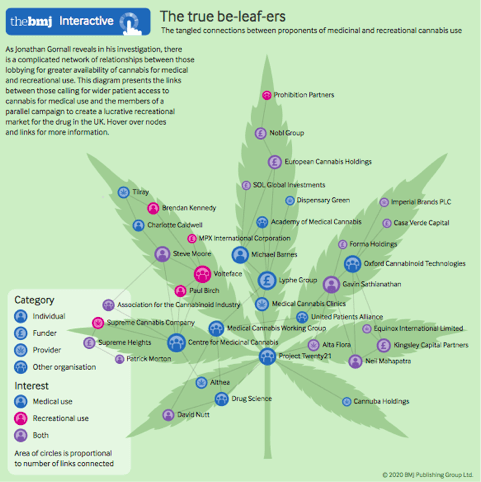
The involvement of such groups suggests that soulless, profit-hungry companies sense an opportunity to grow their profits through legal ‘medical’ or recreational cannabis in the UK. It seems unlikely that such groups are throwing their weight behind cannabis campaigning in order to enact a public good, seeing only pound signs.
In his book ‘Reefer Sanity’ Kevin Sabet, a former drug policy advisor to the Obama administration, describes how big tobacco, and the corporate machine more generally, has cashed in on the US-Canada cannabis market.
Cannabis has been commercialised in much the same way cigarettes were throughout the 20th century. Products and advertisements present getting stoned as safe, fashionable and even healthy and are often targeted at teens, knowing that the younger generation is the most lucrative market. In recent years, investment in cannabis edibles – foodstuffs laced with psychoactive compounds – have risen in popularity with lollipops, gummy bears and other childish treats legally for sale in shops. Coincidence?
A legal cannabis market in the UK would be seized upon by capitalists like any other legitimate industry and this would mean more money for the Government but at what cost?
Alcohol is a legal drug, bringing billions in tax revenues each year. However, the societal good that results from alcohol taxation is mitigated by the fact that every year the NHS and the police spend billions dealing with alcohol-related harms. It affects people’s health, leads to crime and results in numerous deaths each year due to drink driving. Given the proven psychological harms of cannabis, legalising the drug would also cost society dearly. Generating higher tax revenue from legal cannabis is ethically dubious when you consider these risks.
Warning signs
Returning to the metaphor of a gathering storm, let’s consider what stage we are at in the UK. Is cannabis law reform a faint cloud above the horizon? Or are we already under a rapidly darkening sky? When will the downpour ensue?
Given the rapid rate of cannabis law change in other countries during the last decade, and the growing voices in UK politics and culture advocating a different approach, it’s fair to say the storm clouds are well-gathered. Already there are strong indications that the downpour of all-out campaigning or even legislation isn’t that far away.
One of the most telling signs is the frequency of coverage concerning ‘medical cannabis’.
At the end of the last year, a couple of cases of children with serious health conditions who use cannabis products hit the headlines. In Northern Ireland, the family of Billy Caldwell, who suffers from epilepsy, was granted permission by the Home Office to import cannabis-based medicine from Europe to treat his condition. His mother had been threatened with legal action for importing the product previously as it hadn’t undergone medical trials in the UK.

The concept of ‘medical cannabis’ requires careful navigation. There is good evidence that medicines derived from cannabis are effective in treating certain conditions. In the UK, a mouth spray called ‘Sativex’ has been prescribed to patients for several years. The cannabis plant contains more than 100 active compounds and some, including cannabidiol (CBD), have been shown to have therapeutic value. More research is needed to discover which other compounds in the plant have beneficial properties.
However, in order to be safe for consumption, these compounds need to be divorced from psychoactive compound Tetrahydrocannabinol (THC), which is linked to psychosis and other negative mental health outcomes.
In the US and Canada, ‘medical cannabis’ laws allow cannabis dispensaries (dressed up like pharmacies) which patients can visit to pick up raw forms of the drug. Anyone with a sick note for a sore knee, or broken wrist can, in theory, get hold of weed to ‘treat’ their condition by smoking a joint or lighting up a bong. This isn’t good medical practice and has effectively proved a Trojan horse for legal recreational cannabis.
Decades ago Keith Stroup, founder of NORML, a leading pro-cannabis campaigner, admitted that the pro-cannabis lobby was using the idea of medical cannabis as a “red herring” to bring about decriminalisation. In 1979, in an article for US newspaper Emory Wheel, he wrote:
“We are trying to get marijuana reclassified medically. If we do that (we’ll do it in at least 20 states this year for chemotherapy patients) we’ll be using the issue as a red herring to give marijuana a good name. That’s our way of getting to them indirectly, just like the paraphernalia laws are their way at getting to us”.
The pro-cannabis lobby aren’t coming at the UK naively. They’ve succeeded in normalising and legalising the drug in numerous US States by advocating ‘medical cannabis’ and using emotive rhetoric – ‘cannabis helps chemotherapy patients’ – to achieve their goal.
Tellingly, the BMJ investigation mentioned above reveals a connection between Charlotte Caldwell, mother of Billy Caldwell, and other pro-cannabis figures. Those in favour of recreational cannabis latch on to vulnerable individuals as part of their wider campaign to soften attitudes towards the drug. Whenever a high-profile case of a child needing cannabis-based medicine is in the news, pro-cannabis propaganda is sure to follow.
Rain drops
The clamour for legal cannabis gathers pace and it will only be a matter of time before serious campaigning begins for legal change in the UK. As Westminster holds the key to drug law reform, the rain drops will arrive there first. Should the law change, Holyrood will likely follow suit.

In a few months time, when COVID-19 has decimated the economy and the Government is eager for ways to boost economic growth, the danger of a successful campaign for legal cannabis, whether through the proxy of ‘medical cannabis’ or via outright decriminalisation, cannot be overstated. Society must be wise to the smoke and mirrors that will be deployed.
The pro-cannabis lobby will argue that a regulated cannabis market would bring huge economic benefits. However, the social costs outweigh any perceived benefits of such a move. They will argue that ‘cannabis is safer than alcohol’. But research shows cannabis causes serious harm. And they will argue that legal cannabis beats crime. But evidence from abroad shows this isn’t the case.
The arguments for legal medical or recreational cannabis can and must be countered strongly.
The Christian response
For the church, the prospect of cannabis law reform is as serious as other moral issues facing Christians today. At present, cannabis use is prevalent while it’s still an illegal drug. The legalisation of cannabis would normalise its use and lead to far more people smoking it.
As Christians, we are told to love our neighbours as ourselves. This means seeking to defend them from exposure to a drug that could cause serious mental illness, anxiety and depression – a drug that would especially harm the young and the poor, who have less access to education and employment.
We must also rail against the prospect of powerful groups like big tobacco targeting teenagers with cannabis products and advertising in order to reap financial profits. It’s no different to the gambling industry or the pornography industry which profit form the harming millions of human beings, lured into the trap of gambling addiction and sexual immorality.
Loving the society around us, and the people in our congregations, means putting their best-interests first, even if that means going against the trend. In the words of Isaiah: “Learn to do good; seek justice, correct oppression; bring justice to the fatherless, plead the widow’s cause” (Isaiah 1:17).
The storm of cannabis reform is coming but it’s not the time to duck under cover. We need to be out there, defying the downpour and fighting for the protection of the vulnerable.
 salann