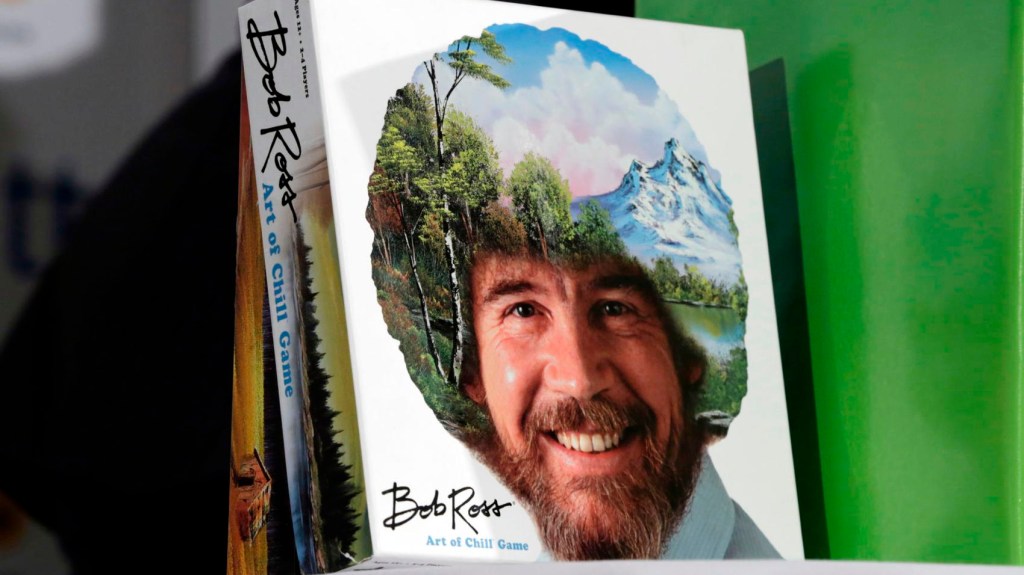
Ten years ago the name Bob Ross wouldn’t have been on the radar of many people in Scotland.
The eccentric Californian painter, art instructor and television host died of cancer in 1995 after recording several seasons of his show ‘The Joy of Painting’ for the American Public Broadcast network. However, as Radio 4 reports this week, Ross has amassed somewhat of a posthumous cult following amongst young people today. The Joy of Painting was uploaded to YouTube shortly after Ross’s death and episodes of the programme have garnered millions of views.
To the uninitiated – be initiated! There’s nothing quite like watching Bob Ross paint. He’s a character. Standing in his trademark blue shirt and jeans, with afro hair, a giant palette in one hand and a brush in the other, Ross conjures up magnificent scenes from nature on the canvas in a matter of minutes. Most episodes he produced are only around twenty minutes long but as you watch him, transfixed, lochs, hills, trees and sunsets appear effortlessly with a few deft strokes of his brush.
If his painting’s impressive, so too is his commentary. Ross became known for wee witticisms rolling off his tongue as he painted as fluidly as the paint rolled off his brush. ‘Let’s make a happy little cloud’. ‘There’. ‘He needs a friend so let’s give him one. Everybody needs a friend’. You can observe Ross at work in the video below.
Yesterday, Radio 4 aired a feature on Ross and his resurgence in pop culture. It attributed the popularity of The Joy of Painting amongst young people today to the fact that it is a relaxing and stress-relieving programme to watch.
Radio 4’s website states that Ross’s “gentle manner presenting his real-time paint-along technique, peppered with advice about life itself, provides an alternative form of therapy – reducing anxiety, relieving stress and aiding sleep”. Quoting the painter, it adds: “‘You absolutely have to have dark in order to have light.’ This sentiment from television art instructor Bob Ross is perhaps more resonant than ever at the present time.”
The Radio 4 programme features young people and adults who struggle with anxiety and depression and who find an escape in The Joy of Painting, whether they are watching it or actively painting along with Ross.
It’s a slightly odd phenomenon – young folks in the UK turning to an eccentric American painter, big in the 80s and 90s, as an antidote to stress and poor mental health, but it does make sense. Ross’s programmes are warm, encouraging and gently humorous, and they develop at a slow pace – a pace that is apposite to the manic technological age in which we live. They beckon the viewer to come in, take a seat, smile and switch off from the world around them.
Young people today are glued to constantly refreshing social media feeds, bombarded by emails, adverts, and music, and surrounded by traffic and crowded streets. They’re encouraged to be constantly introspective, to strive towards an ideal of fitness and outward beauty that’s unattainable, and to keep up with an ever-changing catalogue of cultural trends – at all times comparing themselves to a plethora of peers in the digital world. Their senses are bombarded by a never-ending cacophony of lights, sounds and motion. It’s utterly exhausting. The fact that The Joy of Paining is attractive to such frazzled human beings isn’t surprising at all.
“Young people’s senses are bombarded by a never-ending cacophony of lights, sounds and motion”
There’s a lesson in all this for the church as it seeks to come alongside the younger generation in 21st century Scotland. An estimated one in three people are affected by a mental health problem every year in Scotland with young people among the most susceptible to anxiety and depression. There’s no doubt that culture, alongside other factors like family breakdown and drug and alcohol abuse, plays a factor in this. The pace of life which young people live today is relentless and world’s away from the experience of young people a couple of generations ago. As the church, we need to be cognisant of this.
In his excellent book ‘Reset’, Christian pastor and author David Murray addresses the problem of burnout amongst pastors, providing lessons that are useful to anyone struggling with stress and mental illness.
Murray describes how discipline is important in maintaining good mental health and says this can be achieved by simple things – good sleep, good diet, regular exercise and a sensible work/life balance. With some jobs, and with social media, it’s possible to never switch off, to constantly be plugged in and on-edge and this can be devastating to mental and physical health. He speaks from personal experience, having survived a blood clot in the lungs that he attributes to overwork as a church minister.
Of course, good spiritual discipline underpins all these things. Building in time for the reading of scripture and prayer – to be still before God – is essential to good spiritual, mental and physical health. We need to understand the teaching of scripture as it relates to looking after the body and the mind. Murray notes that Christ often withdrew to rest and pray. In Mark 6, Jesus tells the disciples: “Come with me by yourselves to a quiet place and get some rest.” Overwork, bad social media habits and a refusal to rest does not honour the body as the temple of the Holy Spirit. Running ourselves into the ground is not pleasing to God. And staying up late, glued to a screen, isn’t a passive activity – it’s draining. The Bible’s teaching on rest is an encouragement – Jesus us wants us to relax!
Bob Ross may be a salve to those experiencing burnout culture but as Christians, we know the true giver of rest. Let’s understand Christ and model his pattern for living to a weary, watching world.
 salann