The Editor, 21 April 2020
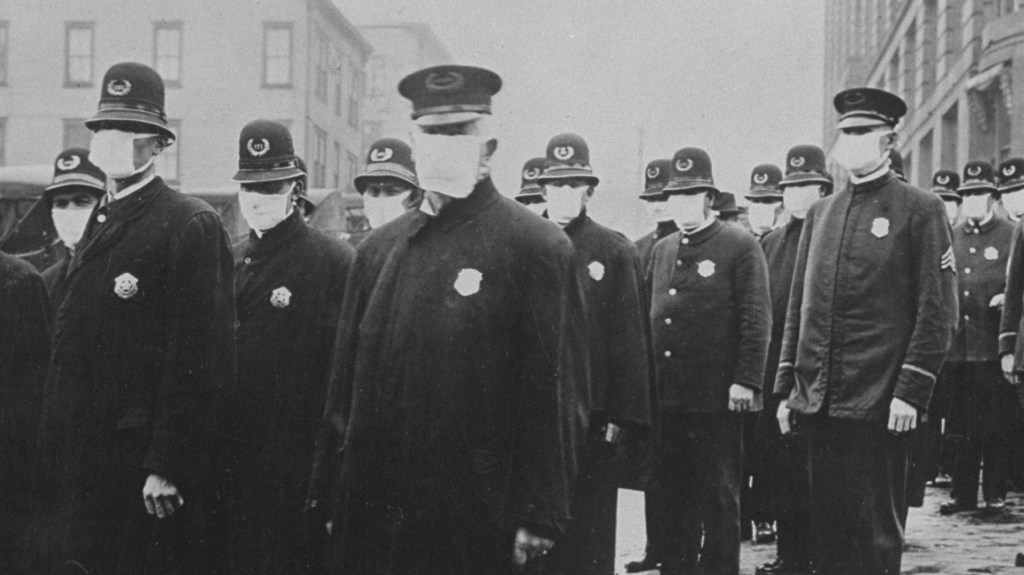
Parallels have been drawn between COVID-19 and the ‘Spanish Flu’ of 1918, the last major pandemic to afflict the modern world.
Spanish flu began in spring 1918, peaked in the autumn and returned in spring of the following year. It is thought to have infected 500 million people in total – a third of the world’s population at the time – and killed 50 million by the time it petered out.
The virus spread rapidly because it coincided with the end of the First World War. In the months following the conflict, which involved more than 100 countries, soldiers travelled home and they took the flu with them.
The years following 1918 are recognised as some of the hardest in British history. The First World War claimed the lives of around 700,000 British soldiers and by 1919, 228,000 had died from Spanish Flu. There was barely a home in the whole of the British Isles that was untouched by tragedy.
Secular historians argue that terrible events like the Spanish Flu and World War 1 caused people to question the very existence of God and spurred a general drift away from Christianity in successive decades. Whilst church attendance has declined in the UK since the early 20th century, it has by no means been a continuous, uninterrupted decline, and there are treasured periods of spiritual renewal.
Those of us raised as Christians in the UK will be familiar with the great revivals of the 20th century in various parts of Scotland, England, Wales and Northern Ireland.
Personally, I’ve always been transfixed by the Lewis Revival of the mid 20th century, due to the strong family connection I have to the island. The story goes that following a period of faithful prayer by two elderly sisters hundreds of people, from various walks of life, surrendered their lives to Christ. The revival affected the island and its culture acutely and shaped Christianity in the Highlands and Islands for decades to come. It is considered one of the most amazing spiritual awakenings ever to have gripped Scotland.
Widespread revival can happen at any time and in any place. Historically, it has tended to come after periods of great socio-political intrigue, or national tragedy. For example, the great eighteenth century revival, led by great preachers like John Wesley and George Whitfield, followed a turbulent period of civil war, regicide and the Great Fire of London. The nineteenth century ‘great awakening’ coincided with rapid industrialisation, city growth, and globalisation. And the Lewis Revival came after the Second World War.
It was no surprise therefore to learn that the years immediately after the Spanish Flu and the First World War also saw significant revival in various parts of the UK, including Scotland.
In his seminal book ‘Glory in the Glen: A History of Evangelical Revivals in Scotland 1880-1940’, historian Tom Lennie notes that significant revivals occurred in various parts of Scotland between 1919 and 1923 – despite a philosophical ‘hardening’ of young men towards religion after their experiences in the war.
Lennie writes, “many servicemen returned to civilian life demoralised, bitter and sceptical. Their mood was further lowered when the brief boom in the British economy that characterised the immediate post-war period quickly gave way to economic depression and mass unemployment.”
Remarkably, despite the “deeply demoralising effects the First World War had on many of the young men drafted into the forces” Lennie states that “a powerful evangelical revival [rose] up in many towns and villages along the east coast of Scotland and East Anglia in its immediate aftermath, causing hundreds of young people to flock to crowded church meetings night after night”. Revival first occurred in small fishing communities like Westray, Orkney, Cockenzie near Edinburgh, Wick, Peterhead and Fraserburgh before spreading further afield.
These local post-WW1 revivals are a wonderful demonstration of God’s mercy, and they present both an encouragement and a challenge to the church in Scotland today.
The encouragement is this: God is able to, and often does, move in troubled places, overcoming seemingly huge philosophical or logistical barriers. We can have confidence that the Spirit of God can open the hearts of Scots today – however sceptical or hostile they may be towards Him. God may be pleased to move in Scotland in the months after COVID-19 and bring hundreds of men and women into a relationship with Jesus Christ and we should certainly pray for this.
Now here is the challenge: Will you, Christian, faithfully share the Gospel with friends, family members, work colleagues and neighbours and make the most of the opportunities you have just now, recognising that the “night is coming, when no one can work” (John 9:4)?. Many people are more conscious of the frailty of life and open to having deeper conversations because of the effects of COVID-19.
Some may question the existence of God in the wake of the coronavirus. A couple of weeks ago, atheist author Richard Dawkins cynically highlighted that coronavirus deaths in the United States greatly increased in the week after Donald Trump’s ‘national day of prayer’. But there is no reason to fear such logic as this. We worship the God who wrote history, who sent his son to die for us, and who is redeeming this fallen world.
I leave you with the words of John Lennox, Oxford University Professor and apologist. Responding to questions about God’s role in COVID-19, he wrote:
“…when we look at the world, we are faced with the kind of mixed picture presented by a ruined cathedral – with all the beauty of the opening of a flower to the sun, and all the ugliness of a coronavirus destroying the human respiratory system. And, just as there is good and evil in creation, and in humanity in general, so there is good and evil in each one of us. We too are part of the problem.”
“[But] Because of the death and resurrection of Jesus, those who repent of (which means ‘turn away from’) their own evil and their own contribution to human pain and suffering – those who trust Jesus as their Lord – receive forgiveness; peace with the personal God who created and upholds the universe; a new life with new powers; and the promise of a world where suffering will be no more. Here Christianity does not compete with any other philosophy or religion – for the simple reason that no one else offers us forgiveness and peace with God that can be known in this life and endures eternally.”
 salann